
Rabbit Diet

Best pellets for rabbits.
Disclaimer: This post contains affiliate links.
A new rabbit lover or owner often times do not understand the importance of a healthy diet for a rabbit. What if I say you that choosing only the best pellets for rabbits can enhance your rabbit’s health a lot.
Are you confused about what type of foods are best for rabbits? In this article, I will explain the importance of rabbit pellets for your rabbits, and which pellets to buy for both young and adult rabbits.
Adult rabbits that are over 7 months old need hay pellets that contain more fiber and less protein, on the other hand, a young rabbit requires more protein in the pellets for their growth.
To better understand how to choose the best pellets for rabbits continue reading. If you want to listen to the audio then click the video below.
Best pellets for rabbits.
Rabbit pellets play an important role in a rabbits diet. Similar to rabbit hay which helps rabbits in many different ways, rabbit pellets aids domestic rabbits to get the necessary nutrition for their better health.
Due to the reason, domesticated rabbits grow in a household and depends only on the food provided by their guardians, they cannot get enough green vegetables or hay grass,
A rabbit in the wild has an unlimited supply of hay, dried grass, leafy greens, hence they do not require rabbit pellets to remain in good shape.
Why does this matter?
Although rabbit guardians intend to provide their pet rabbits with a lot of greens, it is not always possible.
80% of a rabbit’s diet must consist of hay or dried grass for a vigorous digestive system. Other than that a rabbit needs green vegetables and water to keep themselves hydrated.
As well as green vegetables give rabbits all the nutrition required for good health.
Understand this lack of leafy greens and vegetable varieties in a rabbit’s menu will result in a malnutrition rabbit.
If a rabbit guardian cannot provide their rabbit plenty greens or only occasionally, simply then you must give your rabbits to eat pellets.
Pellets are a good alternative for rabbits to obtain all the nutrition to remain in flawless health.
NOW
Constantly choose pellets depending on your rabbit’s age with many other circumstances.
Any rabbit that is younger than 7 months must feed on alfalfa hay based pellets. Rabbits older than 7 months which is considered an adult rabbit must only feed on Timothy hay based pellets.
Rabbit pellets ingredients.
Rabbit pellets are made from hay. Depending on the brand you choose to buy the pellets may contain seeds and nuts in it,
I must say this, pellets with occasional treats like nuts and seeds in the packaging are not very healthy for rabbits.
As well as some brands of rabbit pellets are colored and some are non-colored. I always choose a pellet that is non-colored.
A non-colored pellet brand is definitely better for this delicate small pets opposed to the colored ones.
Timothy hay based pellets are made from timothy hay and contain more fiber and less protein,
Alfalfa hay pellets contain more protein compared to the timothy hay pellets.
Are pellets bad for rabbits?
NO, pellets are not bad for rabbits at all if they are fed the correct amount.
Unless you overfeed your pet rabbits with pellets and failure to recognize which type of hay pellet is best for adult and young rabbits can become fatal for rabbits.
Purpose of feeding pellets to your rabbits is to give them the necessary nutrition which may have been lacking in their diet.
However, if you are feeding your rabbits with sufficient green vegetables and leaves, it is fine if you do not feed them pellets.
Too much green vegetables together with regular feeding of pellets can be harmful to their health. Understand this too, often times your rabbit veterinary will ask you to stop feeding pellets to your rabbits.
What should I look for in rabbit pellets?
When you are purchasing rabbit pellets continuously choose the rabbit pellets according to your rabbit’s age and weight.
Before you decide on a brand of pellets, check the nutritional value of the particular brand of pellet on the back side of the packaging.
Rule of thumb:
- A rabbit pellet must have at least 22% crude fiber;
- Maximum of 14% Protein;
- 1% Fat;
- Not more than 1% calcium.
A rabbit below 7 months old needs to grow and requires more protein in their diet. Hence choose alfalfa hay pellets for your young rabbits and a brand of pellet with no coloring.
Same goes for the rabbits over 7 months old. Before you buy a brand of pellet for your adult rabbits choose Timothy hay based pellets and with no coloring.
If you feed alfalfa hay to your adult rabbits which contain more protein will result in an overweight rabbit.
What can rabbits eat instead of pellets?
Replacing pellets in a rabbits diet are only possible by giving your rabbits all the food that has the same nutritional value required for a healthy rabbit.
A rabbit must chew on grass hay, dried grass continuously.
Eating plenty of green vegetables and leaves together with occasional treats is normal.
When you are sure that your rabbit is having all the required vitamins and minerals and enough fiber daily in their diet, then you can go for a pellet-free diet for rabbits.
Otherwise, it is best to keep pellets in the rabbit’s diet. To understand how much pellet is good for rabbits:
Go to the heading “Are pellets bad for rabbits” and read again.
Also, check this pdf by rabbit.org to understand the rabbit diet >>> Rabbit food pyramid.
Read here to comprehend >>> What not to feed your pet rabbits?
Want your rabbit to be happy and healthy?

Need other things for your rabbit?
Click on the links below for:
Rabbit food
Rabbit Toys
Rabbit cages and houses
Rabbit health and hygiene


Best Hay for Rabbits: A Complete Guide to Types, Quality, and How Much to Feed
Best Hay for Rabbits: A Complete Guide to Types, Quality, and How Much to Feed
If you get one thing right in rabbit care, make it hay. Not the enclosure size, not the brand of pellets, not the vegetable rotation — hay. Hay is not a supplement or an optional enrichment item. It is the single most important component of a rabbit’s diet and the primary driver of long-term health or disease.
Yet the majority of rabbit owners significantly underestimate how much hay their rabbit needs, choose the wrong type for their rabbit’s age, or buy hay of such poor nutritional quality that it offers little benefit. This guide covers everything you need to know: why hay is non-negotiable, how to choose the right type, what quality looks and smells like, how much to feed, and which situations call for different hay varieties.
Why Hay Is the Foundation of Rabbit Health
Rabbits are hindgut fermenters — their digestive system is designed to process large quantities of fibrous plant material continuously. Unlike dogs or cats, whose digestive tracts are adapted for periodic large meals, a rabbit’s gut must keep moving at all times. When it slows or stops — a condition called gastrointestinal (GI) stasis — the results can be fatal within 24–48 hours.
Hay accomplishes two things no other food can: it provides the long-strand indigestible fiber (also called “structural fiber” or ADF — acid detergent fiber) that physically keeps the gut moving, and it mechanically wears down a rabbit’s continuously growing teeth. Rabbit teeth grow approximately 2–3mm per week throughout the animal’s life. Without the lateral grinding motion required to chew long-strand hay, the teeth develop sharp spurs and malocclusion — the leading cause of dental disease and a major driver of euthanasia in pet rabbits.
A 2012 study published in the Journal of Exotic Pet Medicine found that dental disease affects an estimated 7–12% of pet rabbits examined in clinical practice, with diet — specifically insufficient hay — identified as a primary modifiable risk factor. The same body of research confirms that rabbits fed ad libitum hay (unlimited, always available) have significantly lower rates of both GI stasis and dental malocclusion than those fed restricted hay diets.
The Rabbit Welfare Association & Fund (RWAF), one of the leading rabbit welfare organizations in the world, states plainly: hay should make up at least 80–90% of a rabbit’s total diet by volume and must be available at all times without restriction. There is no upper limit on healthy hay intake.
Types of Rabbit Hay: Which Is Best?
Not all hay is the same. Different grass species have different nutritional profiles, fiber content, and appropriate life-stage uses. Here is a breakdown of every major hay type your rabbit might encounter.
Timothy Hay — The Gold Standard for Adult Rabbits
Timothy grass (Phleum pratense) is the most widely recommended hay for adult rabbits and the one most rabbit-savvy veterinarians reach for first. It has an ideal fiber-to-protein ratio for adult maintenance: approximately 32–34% crude fiber, 7–8% crude protein, and a relatively low calcium content (~0.4%). This profile supports gut motility, dental wear, and a healthy body weight without the excess calcium that can contribute to urinary sludge and bladder stones in adult rabbits.
Timothy hay is sold in three “cuts” based on when in the growing season it was harvested:
- First-cut timothy is harvested earliest in the season. It is coarser, stemmier, and higher in fiber. Rabbits who need extra dental wear or tend to be overweight do well on first-cut. Many rabbits find it less palatable than later cuts, but the higher ADF content makes it the most beneficial for gut health.
- Second-cut timothy is harvested after regrowth. It has a balance of leaf and stem, moderate fiber, and is the most commonly available type in pet stores. Most adult rabbits eat it readily, and it is a solid all-purpose choice.
- Third-cut timothy is the softest and leafiest, with the highest protein and lowest fiber content of the three cuts. It can be useful for senior rabbits with dental pain who struggle to chew coarser hay, but it should not be the primary hay for healthy adults due to its lower fiber content.
Orchard Grass Hay — The Best Alternative to Timothy
Orchard grass (Dactylis glomerata) is the second most commonly recommended hay and, for many rabbits, the preferred choice. It has a nutritional profile very similar to second-cut timothy — high fiber (~34% crude fiber), moderate protein (~9%), and low calcium. Where orchard grass stands out is in palatability: its softer texture and slightly sweeter scent make it more appealing to hay-reluctant rabbits.
Orchard grass is also the go-to recommendation for rabbits and owners with timothy hay allergies — a genuine issue, since timothy pollen is one of the most common grass allergies in humans. If you or someone in your household sneezes around timothy hay, switching to orchard grass provides equivalent nutrition without the allergen.
Orchard grass and timothy can be fed interchangeably or as a blend. Many rabbit owners find that rotating between the two keeps rabbits interested and eating enthusiastically.
Meadow Hay — Variety and Enrichment
Meadow hay is a mixed grass hay harvested from natural meadows rather than cultivated fields. It contains a blend of grasses, wildflowers, and herbs — the kind of dietary variety wild rabbits naturally seek. Nutritional content varies considerably between batches depending on the specific mix of plants, so it is best used as a supplement to a primary timothy or orchard grass hay rather than as the sole hay source.
The variety in meadow hay makes it excellent for enrichment and for rabbits who have become bored with uniform hay. Mixing a handful of meadow hay into the main hay rack can encourage more enthusiastic foraging behavior and increase overall hay consumption.
Oat Hay — A High-Fiber Treat Hay
Oat hay is harvested from oat plants before they fully mature, when the seed heads are still green. It has a high fiber content similar to timothy, and the presence of the oat seed heads makes it very palatable — most rabbits love it. However, once the oat seeds mature and dry, the seed heads become starchy and calorie-dense, so oat hay is best fed when the seeds are still green, or used sparingly as an occasional supplement rather than a primary hay for weight-conscious rabbits.
Botanical Blends — Premium Enrichment Options
Botanical hay blends combine a base grass hay (usually timothy or orchard grass) with dried herbs, flowers, and other plants — chamomile, rose petals, lavender, dandelion, nettle, and others. These blends are nutritionally similar to their base hay but provide additional olfactory stimulation and foraging enrichment. They tend to cost more per pound and are best thought of as a palatable supplement for hay-reluctant rabbits or as enrichment rather than a cost-effective daily staple.
Alfalfa Hay — For Young Rabbits Only
Alfalfa (Medicago sativa) is a legume, not a grass, and has a fundamentally different nutritional profile from grass hays: approximately 15–17% crude protein (roughly double that of timothy) and 1.2–1.4% calcium (three times higher). This makes alfalfa appropriate — and genuinely beneficial — for rabbits under 7 months of age, pregnant or nursing does, and significantly underweight rabbits requiring nutritional rehabilitation.

Bunny Facts for New Owners.
Disclaimer: This post contains affiliate links.
When I first decided to get a bunny for myself, I was completely unaware of the facts which every bunny lover needs to know.
At that time, instead of doing a google search, I asked my friend who is a dedicated rabbit lover regarding all the considerations of having pet rabbits.
Although today I can write about many more topics around house rabbits, I have decided to create a list only of TOP 10 Bunny Facts for New Owners.
Today after half a decade of having pet rabbits I have realized there is no end to the factors which every rabbit lovers learn about along the way.
I have created this infographic with the help of this article at Petplace. This infographic explains all the bunny facts for new owners.
Petplace did a very good job of explaining all the important facts in a short yet comprehending way.
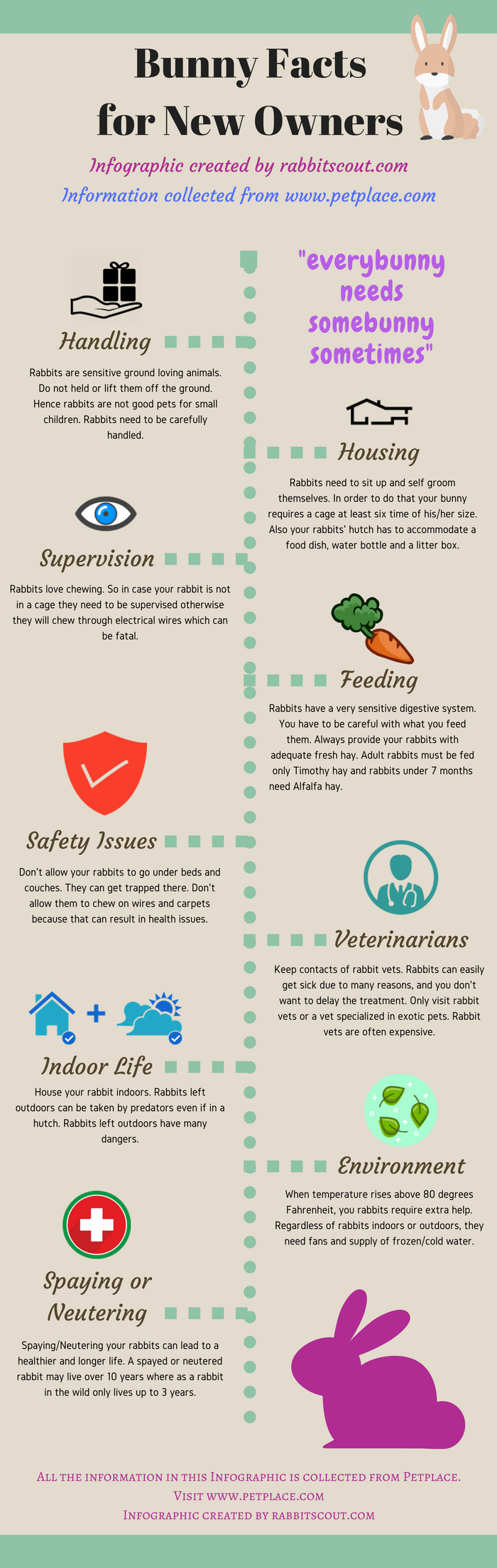
Bunny facts for new owners.
This infographic only explains the very few considerations a rabbit owner must have. There are so many other facts and stories rabbit owners can share with you.
But saying that much information to a new rabbit owner will be overwhelming. Too much information can discourage anyone who is willing to buy rabbits.
Whether you have acquired new rabbits or you intend to bring a couple of rabbits home, these 10 facts are where to begin with.
Eventually, you can learn a lot more from your own time spent with your rabbits.
Bunnies are an excellent companion and very intelligent animals. You will surely enjoy your time with them.
If you have already decided to buy rabbits regardless of any facts, I must say read this article about rabbit cages here >>> Comfortable Rabbit Cages for Happy Rabbits.
Do you know what to feed your rabbits?
Then go here to find the best quality of rabbits foods >>> Rabbit Foods for Vitality.
If you have liked this Infographic, please share it or pin it.
Want your rabbit to be happy and healthy?
Need other things for your rabbit?
Click on the links below for:
Rabbit food
Rabbit Toys
Rabbit cages and houses
Rabbit health and hygiene